Friday, November 8, 2013

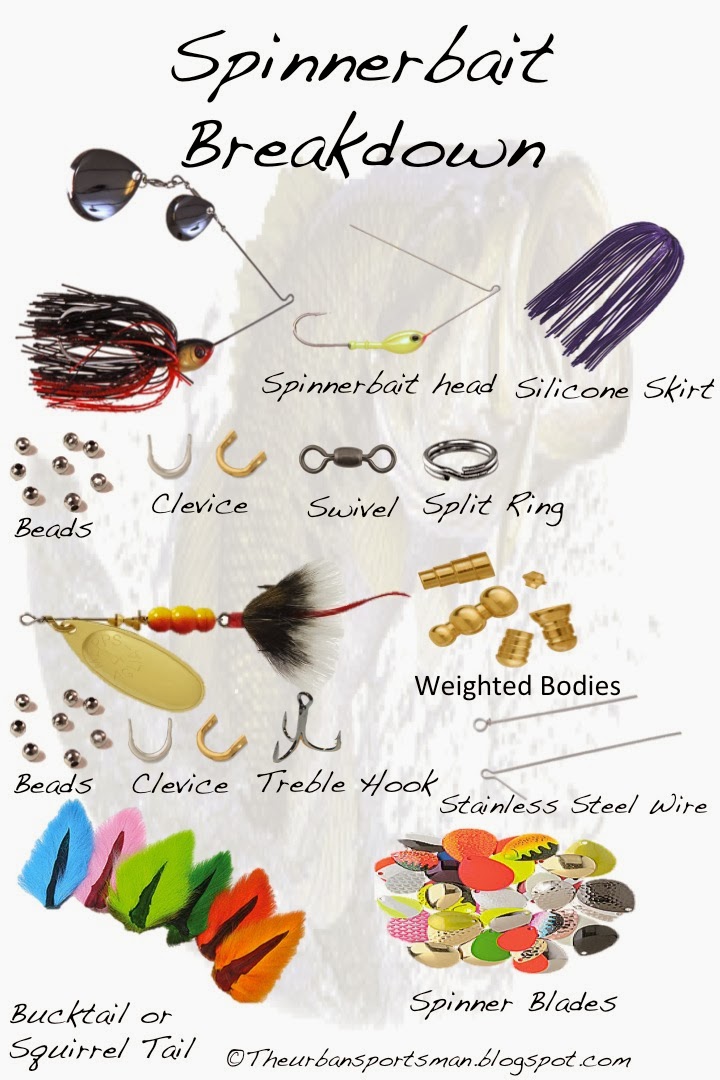
Understanding SpinnerBaits Pt. 1 "SpinnerBait Breakdown"


Types of Spinnerbaits:
Many fishermen and women will tell you that spinnerbaits are probably the most versatile lures. Primarily because they can be effective under pretty much any conditions.  They'll work for you in every season; in cold, cool or hot water and no matter what the weather is like. (well except through the ice) As well they can be used and effective in fresh or saltwater for just about any species.
To start spinnerbaits fall into a two different categories with a few sub-categories beneath one of the two.
1. Inline spinners
The first category and probably the oldest of the two are the inline spinners.  Inlines are pretty simple they have a hook dressed with fur or feathers of some sort attached to stainless steel wire with a weighted body portion and a single or double spinner blade.  These baits are amazingly effective and amazingly under appreciated by many people, except maybe trout fishermen.  In fact many bass fishermen tend to think of inlines and more of a child's bait.  But despite being deemed an easy bait to fish plenty of largemouth, smallies and a plethora of other species has succumbed to the flutter of an inline spinnerbait. Inlines are simple to use: cast, reel and hold on tight when something grabs it.

2. Elbow, safety pin or bass spinnerbaits
These guys tend to be what most people think of when they think of spinnerbaits.  They're characterized by their elbow shaped wire connecting a weighted head and spinner blades. These spinnerbaits have a few sub-categories that fall beneath them.

     A. Single bladed baits which tend to allow for a slower retrieve and are great in deeper water.  Single bladed spinners are a great bait when the fish seem to be a bit stubborn about biting as well as a great bait in colder water.

     B. Tandem bladed baits work best in murky water as they produce more vibration and flash than their single bladed brothers.  They also are great baits to be retrieved over thick grass and cover.

     C. Twin spins are great to option when you want to retrieve your bait just above the bottom for fish that are hovering on the bottom.

Blades: 
The blades on spinnerbaits are the primary fish attractant.  They spin producing flash, sound and vibration, which sends signals to the majority of a fish's primary senses.  Obviously the blade's reflective surface appeals a fish's sense of sight.  As well the sound that the blades emit when spinning through the water appeal to fish's sense of hearing.  This is a great thing, since sound travels faster through water than air, a fish can hear your bait coming from a much further distance and can use sound to key in on your baits in murky water.  Finally the vibration created by the blades attracts fish by alerting the fish via their lateral lines.  Basically the lateral line is an extra-sensory organ that allows fish to use the vibration and in some cases electrical currents of a prey item in order to hone in on it especially in murky water.  It's kind of like fish's sonar system that reads vibration rather than sound.

The blades you choose will determine the depth at which your spinnerbait is best fished at.  As well the blades will dictate the amount of water resistance of your bait has which determines the speed at which it can successfully be retrieved.

Image Source: Learning How To Fish

Blade Styles:
As said before the blade styles affect the sound, flash, vibration and the depths of the different spinnerbaits.  For the most part colorado blades produce the most vibration while willow leaf blades produce the most flash.  While the French blades tend to be a good medium between the colorado and willow leaf blades.
As far as the depths each blade style tends to run at, colorado blades tend to run the highest in the water column due to increased water resistance they create as they spin which produces lift for the bait.  The medium range blades are the indiana, indiana fluted, turtle back and french blades because the spin a little tighter to he wire reducing resistance an causing less lift.  On the other end of the spectrum the inline and willow leaf blades spin the tightest to the wire naturally causing the baits to ride deeper depth than the other blade styles.
Another thing to keep in mind when it comes to spinner blades is the cover being fished.  Spinnerbaits, particularly elbow style, are created for fishing in and around all types of cover but willow leaf blades tend to work the best in heavy cover because of how tightly they spend.

Blade Colors:
Spinner blades come in just about any color you can think of ranging from silver to finishes painted to look realistically like a fish's eye and scale pattern. The color of the blades will determine how much light they reflect as well a what they color reflect within the water.  For fishing in murky water: gold, chartreuse, and white tend to be great colors as they are easier to see by predator fish.  Silver,white and the realistic patterns are great colors for clear water.  I personally chose will switch to white if I feel that the silver blades are putting off too much flash inadvertently spooking fish.
Surprisingly when fishing at night or very overcast days darker colored spinners tend to be a great choices as the darker colors will create a darker shape in the water than the night sky which fish can hone in on.

(Note: blades reflects light in the color that they are thus making them more visible in
murky water, to test this hold a piece of colored paper close to a white wall using the paper as a reflector and watch what color shows up on the wall)

Blade Sizes:
Blade size also affects the resistance, lift and vibration a blade produces as well as the amount of flash it generates.  Just as with blade color you may realize that switching to a smaller blade size in clear water will stimulate more strikes as well but let the fish tell you what they want.  Another thing to consider, specifically with inline spinners, is that if blade should be a little longer than the body portion of the bait if it is not you'll find that the blade will often not spin when retrieved or need to be retrieved at a faster pace in order to spin.

Skirts & dressings:
Just as the blades are attracters of fish so are the skirts and dressings that cover the hooks of your spinners.  The skirts and dressings also have a few other functions:
1. They create greater water resistance which allows the baits to be retrieved slower as well as causing lift.
2. They give the fish something to focus on to and grab.
3. Some say they aide in keeping the spinnerbaits snag free. (but I can't prove this one)
4. Depending on the dressing used they offer different types of movement.

Skirts and dressings range a lot in what can be used.  Many elbow style spinner baits will use silicone skirts, pork rinds, and twister tails.  While many in-line spinners and larger elbow style baits, primarily for pike other toothy critters, will use other materials like bucktail, marabou, squirrel tail and other synthetics.  As well depending on the circumstance, particularly with in-line spinners, some will have no skirt at all in order to get deeper.

Each part of the spinnerbait you use can be traded out and customized to fit the scenarios in which you fish. So don't be afraid to change out any parts of your spinnerbaits as the slightest change may be the difference between getting skunked or feeling your live well.

Thanks for reading and look out for part 2,
Kwan

Tuesday, November 5, 2013

Tips for Being A Successful Hunter

Everyday I read different tips on how to increase your chances as a hunter.  These tips are things we all know, but in many cases, these are things that we fail to remember.  I know I'm guilty of not being consistent. But, despite my failures, I try my best to abide by these simple tips.

1. Scout from home and in the field:
Scouting is something that should be done before and after your hunting season. One of the smartest things you can do is pull up topo maps of the areas you want to hunt that coming season. long before deer season begins. I use google earth to get maps and then print the images on 11" x 17" paper making myself a bingo book of all the properties I'd like to check out.
 
From there, I spend my time hiking and/or shed hunting in these areas in spring, using my day of hiking as an excuse to map different landmarks, food sources, and deer signs.

As the season get's closer, I make sure I get out to see if the travel patterns have changed.  I'll spend my late afternoons sitting near  fields with binoculars and camera in hand waiting to see which trails the deer are using to get to the food sources like soy beans. If you have trail cameras, this is the time to set them out and let your trail cameras do the work for you.  Because I hunt mostly public land, I try not to use trail cameras for fear of theft or alerting other hunters of my plan.

When scouting, you want to use any and every resource you have so be sure to shine at night, where legal, and ask farmers and land owners around where you hunt what they're seeing.

2. Mark the food and water sources
Animals have to eat and drink. So, while you're out there scouting, make sure you're marking the different sources of food and water. Keep in mind that as the seasons change, food and water sources change as well. If  you notice that the deer are happily feeding from feeders you place on your property, please remember that this may change as different food sources become available as the seasons change. This is doubly true for those of us who hunt public land where the deer may be feeding on soft shoots of budding trees, but once nearby corn fields start growing tall enough to hide in, the deer seem to disappear. Get to know what food sources feed your deer herd during different parts of the year.  This year,  I started studying  the different native trees and plants  in my area and which ones bear fruit at different times of the year.

3. Plan entry and exit routes
This tip is the one that many hunters forget.  Make sure you take time to plan out how you're going to get to your stand and out of it without alerting every deer in the woods of your presence.  Make sure you can enter and exit downwind of the area you're hunting and have more than one option just in case the wind is not what you expect when you get into the field.  When you plan this  in advance, it may force  you to rethink your stand locations.

4. Find the does
This is probably the one thing you really want to do especially when the rut is coming on.  If you know
where the does are when the rut is coming up,you can guarantee there will be a few bucks sniffing around for some lovin'.

5. Hunt the hunters
This may sound kind of weird, but it's very important.  You need to know where the other hunters are going to be located in your area.  I don't know how many times I've set up, particularly for gun season, along escape routes that I know the deer will take when the firing starts, helping me fill my tags earlier than the other hunters. Remember, deer rely on their sense of smell, so if you're in an area where you know the deer will be retreating once the scent of humans fills the air, then you're on your way to filling your tags.

You just don't want to be in your stand or ground blind and have some person come tramping through the area you're hunting trying to get to their stand.  We've all been there and it sucks.

6. Hunt along travel and escape routes:
It is very tempting to hunt bedding areas and food sources for deer, but  I don't for a couple of reasons. When it comes to hunting bedding areas, I steer clear of them in order to let the deer have their place of security. If you spook the deer off of a bedding area, there is a fair chance you may change their routines for a while and screw up your chances of harvesting an animal for a while.  As far as hunting food sources, this is something I stay away from because so many other hunters like to crowd the food sources. While it may be effective, there is a higher risk of someone else disturbing your hunt as well as a risk of the deer not coming out until after legal shooting hours.  I tend to hunt the travel routes and escape routes in order to catch the deer passing through and I have little risk of spooking the deer off of a heavily used food source.

7. Control your scent:
We've all heard this before, you must fool a deer's nose if you're going to harvest one.  So make sure you're doing the basics of scent control every time you're hunting.

1. Wash your clothes in scent eliminating detergent.
2. Use cover scents natural to your hunting area.
3. Get dressed in the field.
4. Bathe in scent eliminating soap.

8. Hunt the wind:
Even when you do everything correct with scent control, there is one thing you still have to do in order to fool a deer's sense of smell.  That is hunt downwind of the paths you expect the deer to follow.  Be constantly conscious of wind directions while you're hunting.  If the wind is blowing in a direction that will negatively affect where your normal stand choice, move. Even the best scent elimination techniques are flawed and the wind will snitch on you every time, if you don't pay attention.

9. Be aggressive and flexible when necessary:
Don't be afraid to get out of your ground blind or tree stand and be aggressive when chasing deer or other game.  Even the best ambush points fail sometimes, so get up and don't be afraid to try spot and stalk techniques in order to increase your chances of putting some meat on the table.
Remember that hunting situations will never be exactly the same from day to day, so be flexible and always have a back up plan in case the wind changes or hunting pressure picks up in your area.

10. Journal your hunts:
This is something I do when hunting and fishing.  I consistently keep a journal of my hunting trips in order to learn from my successes and failures.  My journal, along with my map book, keeps me aware of things that may have changed on the properties that I hunt.  For example, storms that may have downed a large number of trees which affects deer movement patterns or bedding areas and new sources of food  may pop up because of farmed land that may not have been farmed the year prior.

11. Learn:
Above every tip I've given in this post, the most important thing is to know that you don't know it all.  There is so much knowledge out there and it's up to you to get out there and learn something new.  Don't be afraid to ask someone more knowledgeable than you and definitely don't be afraid to really study up on the game animal you love to pursue.

I'm sure we all have a tips that can help each other become better hunters so please feel free to let me know some of your suggestions for being a better hunter.


Friday, November 1, 2013

The Tent Commandments


I saw this infographic on pinterest and couldn't help but share it with you guys.  It is a great graphic representation of what we need to do in order to be prepared.  It was created by:  www.outdoorworlddirect.co.uk

Tuesday, October 29, 2013

Man from Ireland Catches Huge Catfish From a Float Tube

If you know me you know I spend quite a bit of my time fishing from my float tube.  The float tube allows you to get into places that are pretty much untouchable by people on boats or on the shore.  To say the least, it's an absolute blast.  There is nothing like being taken for a sleigh ride by a large bass, pike or carp.

However my experience being dragged around is nothing compared to Gerard Smyth of Roslea, Ireland.  You see Smyth was fishing for giant catfish on the Ebro River in Spain with guides from Monster Tours when he hooked into the catch of a lifetime.  A behemoth of a catfish weighing in at 169 lbs.

According to this man on a mission to catch a giant catfish from a float tube, this fish hit a dead dead
Vietnamese Swamp Eel like a "Steam train".  "I didn't realize just how hard it would fight," Smyth said. "Quite a few scary moments throughout, when the float-tube was getting dragged under like a (fishing bobber) with only my head and shoulders above water level.  I finally got the strength to use one armand loosen the drag on the reel a tad as instructed."

Wow!  After a mile long sleigh ride, being pulled around like a man-sized bobber, Smyth was able land the catfish with some help from his fishing crew.
I have to say this get's me riled up to push the limits of my float tube and catch some of the large fish swimming around at the bottom of my local fishing haunts. Congrats Gerard Smyth you're an encouragement to us all!
Pictures and story sourced at grindtv.com.


Saturday, October 26, 2013

Great DIY Ground Blind Idea


I've been looking around at DIY ground blind projects to try this coming year on the property I hunt and came across this youtube video.   The design is very simple and got my creative juices going on some things I can do differently on my own ground blind project.  I can't wait until next spring to get started.  Feel free to check out this video.   Courtesy of Longbowdave Youtube Channel


Understanding Gamefish By Temperature Pt.3: Cold Water Game Fish


LinkWithin

Related Posts Plugin for WordPress, Blogger...