
Showing posts with label spinner. Show all posts
Showing posts with label spinner. Show all posts
Tuesday, May 22, 2018

Sunday, May 1, 2016
A Day of Trout Fishing

Today, I got up excited to get out and get some fishing in. It's the second day of trout season and I've been excited all night because not only was I going trout fishing, but I would get to fish from my kayak as well. No cold waders and jockeying for a good spot, just paddling up, anchoring in and fishing.
After having breakfast with the family, I decided to head to Proud Lake with nothing but trout on my mind
After having breakfast with the family, I decided to head to Proud Lake with nothing but trout on my mind
 Forty-five mintues later, I parked and unloaded my kayak while watching another guy paddle in. He said he hadn't caught didn't any trout, which seemed strange at first, but then made sense when he also said he was out at midnight of opening day and the trout had gotten hit pretty hard that evening.
About 7 minutes into my paddle, I rounded the bend to the spot where I wanted to fish only to be greeted by a huge swan's nest with papa swan sitting there eyeballing me.
Although swans are absolutely beautiful, they can also be very aggressive if you get too close.
My initial thought was to find a new spot but, after a couple seconds of watching me, the swan laid his head down as if to say I won't start any ruckus if you don't. With that, I decided to anchor in about 8 feet from his nest and fish away. After all, I've had worse fishing partners than this guy. Besides, having him as a fishing partner might keep other fishermen at bay.
It only took a few minutes to bait up my Berkley Power Bait rod with pink and white berkley trout bait and my it into the water. It took about 15 minutes of waiting before I caught my first trout measuring 14 1/2 inches. The second trout came a bit later, after I saw it surface about 8 feet to my right, directly in front of my fishing buddy. So I hurried an reeled in my bait and pitched it about a foot in front of where I saw the fish surface. Thirty seconds later and FISH ON! This guy wasn't as easy to pull in because I was anchored so closely to some brush and the he decided it was best to run straight towards it. After playing a mean game of dodge the branches, I had my second trout in the yak and it was time to hit a new spot.
 After stringing up my trout I noticed my fishing buddy had decided it was time for a change of scenery. So, I took a minute to admire him as he swam away. I paddled down stream past a few guys fishing with full stringers and another yak fisherman fighting a stud of a trout. As for me, it was time to get to the blow downs that I knew should be holding a few trout.
I took me a couple of minutes to back my kayak into an area of slack water and get situated once I got to the blowdowns. I cast the power bait under a blowdown only to notice that the current in this area was just too fast to fish in this way. So, I grabbed my ultra-light ugly stick with the wooly bugger spinner tied on it and started casting. About 3 cast in I got hit just below a downed tree. This trout wasn't like the other two. This one decided it wanted to take me for a sleigh ride. With only two pound test line on the ugly stick, I figured it was best to let take me on that ride, within reason. After a few minutes of letting the fish tire itself out, I found a good spot to back the yak into and started reeling the fish in. Two minutes later, I was excitedly talking to the fish for thinking he could get away.
I had reached my limit of fish. So, I left my spot to the two guys wader fishing and headed to the car excited and tired.
Below are the stringer with my days catch and the wooly bugger spinner I was using but in chartreuse and black pattern. I wish there was a way to put my enjoyment on a stringer to show you that too. But, this post will have to do.
Thanks for reading and tight lines.


Wednesday, April 23, 2014
My Easter Fishing Ice Breaker

So this past Easter Sunday I decided, since I had the day off, to get out and jump start my spring bass fishing. So as of the Thursday prior to Easter Sunday I was checking the weather to see if it would be nice enough to get out on the water and chase a few fish. To my pleasant surprise the weather man said the temps would be in the high sixties this Easter and since I stay in Michigan I decided this is a huge blessing as it's not uncommon to get a spring snow fall or bout of very cold rain.

To my surprise when I arrived at the lake at about 10:30 there weren't that many people walking the shore or out on kayaks fishing, just a few of us chasing early season largemouth bass. A couple of guys using large spinnerbaits, one gentleman throwing a rattle trap, another young man using a jerk bait quite successfully and his buddy who was switching up quite a bit from bait to bait.
 As for myself I decided since the water was still cold I'd start out with black and yellow beetle spin which was very successful for me to start. In fact I caught about 5 smaller bass, all between 12 and 15 inches in length. With the beetle spin I found that the bass were actually striking it pretty aggressively despite the cold water, but only when the beetle spin was being slowly and deeply retrieved. So on every cast when the bait hit the water I'd count to seven to allow the bait to drop down just deep enough to be retrieved above the recently emerging grass then slow rolling it back resulting in frequent strikes. After a while and a quick circuit of the point I was fishing I decided to switch back to an old standby of mine, an inline spinner I tie that has a brown wooly bugger as the tail end which I can only describe as a wooly spinner. (I'll post a picture and how to blog later) This made the difference for me this day, because even though this bait isn't much larger than the beetle spin it could be retrieved at a slower rate as well it's undulating wooly bugger tail and gold spinner really gave the bait a more lifelike profile in the cold clear water this day. So while I caught 5 smaller bass on the beetle spin my little wooly spinner drew in another 7 bass 3 of which were over 17 inches.

Thanks for reading,
Kwan & Phil
Saturday, November 30, 2013
A Few Quick Pics of This Year's Late Salmon Trip

This past august I was lucky enough to be able to take a
little time out to go to the west side of the state for a short salmon fishing
and camping trip. It is something my
dad, my hunting partner and myself had been planning on doing since earlier
this summer. However every time we’d
come up with a date it would end up being inconvenient for one party or
another. But eventually we got it together
and made our way up north to the Pere Marquette River to chase spawning salmon.
To say the least, we had a blast. Below are a few pics from our trip. We ended up catching quite few fish over the course of two days, mostly snagging them. However we did manage to catch 10 legal fish. For bait I was using different fly patterns, mostly wooly bugger variations, but the most effective thing was a wooly bugger inline spinner that I make. Which had a few fish biting at it out of aggression since the salmon this late in the spawn don't feed. I'll post the pattern for the wooly bugger spinner that I make in a later post.
Next year I'll making this trip a lot sooner so I can catch salmon while they're still fresh in the river and more aggressive. But this trip was still a lot of fun.
Thanks for reading!

Me holding a decent sized salmon caught on a spinner.

My hunting partner with another nice salmon.
Friday, November 8, 2013
Understanding SpinnerBaits Pt. 1 "SpinnerBait Breakdown"
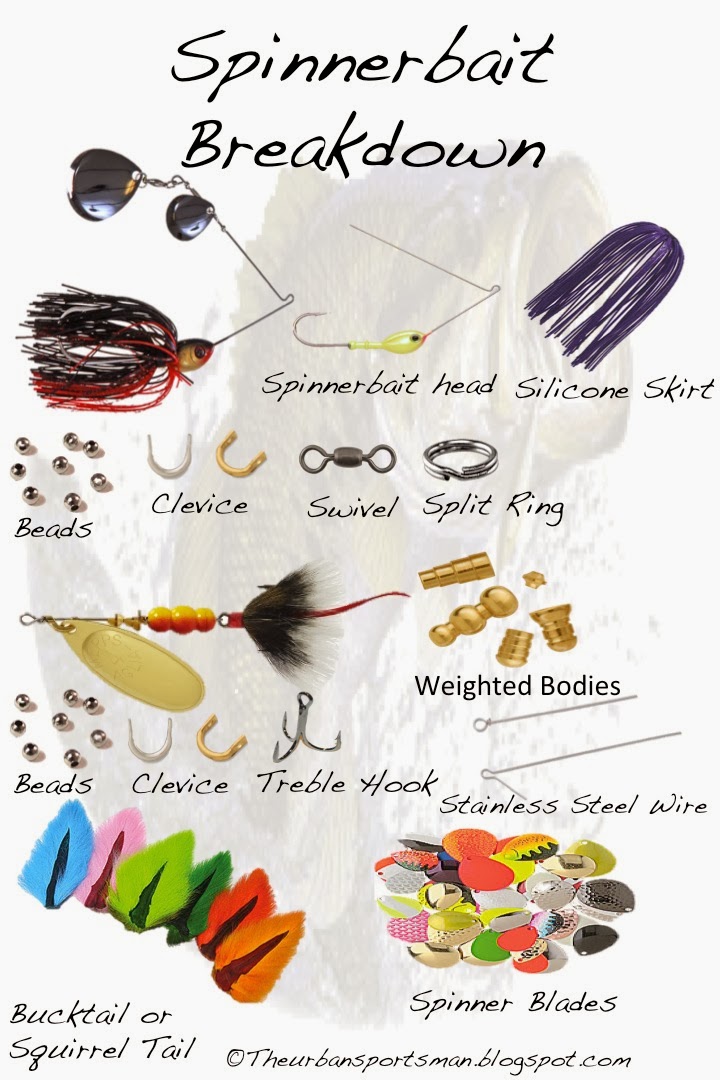
Types of Spinnerbaits:
Many fishermen and women will tell you that spinnerbaits are probably the most versatile lures. Primarily because they can be effective under pretty much any conditions. They'll work for you in every season; in cold, cool or hot water and no matter what the weather is like. (well except through the ice) As well they can be used and effective in fresh or saltwater for just about any species.
To start spinnerbaits fall into a two different categories with a few sub-categories beneath one of the two.

The first category and probably the oldest of the two are the inline spinners. Inlines are pretty simple they have a hook dressed with fur or feathers of some sort attached to stainless steel wire with a weighted body portion and a single or double spinner blade. These baits are amazingly effective and amazingly under appreciated by many people, except maybe trout fishermen. In fact many bass fishermen tend to think of inlines and more of a child's bait. But despite being deemed an easy bait to fish plenty of largemouth, smallies and a plethora of other species has succumbed to the flutter of an inline spinnerbait. Inlines are simple to use: cast, reel and hold on tight when something grabs it.
2. Elbow, safety pin or bass spinnerbaits
These guys tend to be what most people think of when they think of spinnerbaits. They're characterized by their elbow shaped wire connecting a weighted head and spinner blades. These spinnerbaits have a few sub-categories that fall beneath them.
A. Single bladed baits which tend to allow for a slower retrieve and are great in deeper water. Single bladed spinners are a great bait when the fish seem to be a bit stubborn about biting as well as a great bait in colder water.
B. Tandem bladed baits work best in murky water as they produce more vibration and flash than their single bladed brothers. They also are great baits to be retrieved over thick grass and cover.
C. Twin spins are great to option when you want to retrieve your bait just above the bottom for fish that are hovering on the bottom.
Blades:
The blades on spinnerbaits are the primary fish attractant. They spin producing flash, sound and vibration, which sends signals to the majority of a fish's primary senses. Obviously the blade's reflective surface appeals a fish's sense of sight. As well the sound that the blades emit when spinning through the water appeal to fish's sense of hearing. This is a great thing, since sound travels faster through water than air, a fish can hear your bait coming from a much further distance and can use sound to key in on your baits in murky water. Finally the vibration created by the blades attracts fish by alerting the fish via their lateral lines. Basically the lateral line is an extra-sensory organ that allows fish to use the vibration and in some cases electrical currents of a prey item in order to hone in on it especially in murky water. It's kind of like fish's sonar system that reads vibration rather than sound.
The blades you choose will determine the depth at which your spinnerbait is best fished at. As well the blades will dictate the amount of water resistance of your bait has which determines the speed at which it can successfully be retrieved.

Blade Styles:
As said before the blade styles affect the sound, flash, vibration and the depths of the different spinnerbaits. For the most part colorado blades produce the most vibration while willow leaf blades produce the most flash. While the French blades tend to be a good medium between the colorado and willow leaf blades.
As far as the depths each blade style tends to run at, colorado blades tend to run the highest in the water column due to increased water resistance they create as they spin which produces lift for the bait. The medium range blades are the indiana, indiana fluted, turtle back and french blades because the spin a little tighter to he wire reducing resistance an causing less lift. On the other end of the spectrum the inline and willow leaf blades spin the tightest to the wire naturally causing the baits to ride deeper depth than the other blade styles.
Another thing to keep in mind when it comes to spinner blades is the cover being fished. Spinnerbaits, particularly elbow style, are created for fishing in and around all types of cover but willow leaf blades tend to work the best in heavy cover because of how tightly they spend.
Blade Colors:
Spinner blades come in just about any color you can think of ranging from silver to finishes painted to look realistically like a fish's eye and scale pattern. The color of the blades will determine how much light they reflect as well a what they color reflect within the water. For fishing in murky water: gold, chartreuse, and white tend to be great colors as they are easier to see by predator fish. Silver,white and the realistic patterns are great colors for clear water. I personally chose will switch to white if I feel that the silver blades are putting off too much flash inadvertently spooking fish.
Surprisingly when fishing at night or very overcast days darker colored spinners tend to be a great choices as the darker colors will create a darker shape in the water than the night sky which fish can hone in on.
(Note: blades reflects light in the color that they are thus making them more visible in

Blade Sizes:
Blade size also affects the resistance, lift and vibration a blade produces as well as the amount of flash it generates. Just as with blade color you may realize that switching to a smaller blade size in clear water will stimulate more strikes as well but let the fish tell you what they want. Another thing to consider, specifically with inline spinners, is that if blade should be a little longer than the body portion of the bait if it is not you'll find that the blade will often not spin when retrieved or need to be retrieved at a faster pace in order to spin.
Skirts & dressings:
Just as the blades are attracters of fish so are the skirts and dressings that cover the hooks of your spinners. The skirts and dressings also have a few other functions:
1. They create greater water resistance which allows the baits to be retrieved slower as well as causing lift.
2. They give the fish something to focus on to and grab.
3. Some say they aide in keeping the spinnerbaits snag free. (but I can't prove this one)
4. Depending on the dressing used they offer different types of movement.
Skirts and dressings range a lot in what can be used. Many elbow style spinner baits will use silicone skirts, pork rinds, and twister tails. While many in-line spinners and larger elbow style baits, primarily for pike other toothy critters, will use other materials like bucktail, marabou, squirrel tail and other synthetics. As well depending on the circumstance, particularly with in-line spinners, some will have no skirt at all in order to get deeper.
Each part of the spinnerbait you use can be traded out and customized to fit the scenarios in which you fish. So don't be afraid to change out any parts of your spinnerbaits as the slightest change may be the difference between getting skunked or feeling your live well.
Thanks for reading and look out for part 2,
Kwan
Subscribe to:
Posts (Atom)
LinkWithin
