Saturday, March 14, 2015

Product Review: Abu Garcia Silvermax

Company Description:  Lightweight, powerful, and precisely designed, this attractive and affordable Abu Garcia® Silver Max™ Low-Profile Baitcast Reel gives you everything you need, including a handy flipping switch so you can make quick short casts to cover. Other features include five Ball Bearings plus Instant Anti-Reverse™ bearing, graphite frame and sideplates, Power Disk™ drag system, Duragear™ brass gears, and MagTrax™ brake system.
  • Handy flipping switch
  • Five Ball Bearings plus Instant Anti-Reverse bearing
  • Graphite frame and sideplates
  • Power Disk drag system
  • Duragear brass gears
  • MagTrax brake system
Specs:
Gear Ratio: 6.4:1
Line Capacity: 12/145
Braid Capacity: 30/130
Ball Bearings: 5+1
Max Drag: 15 Lbs.
Recovery: 28" Per Turn
Reel Weight (oz): 8


Review:  This is the first baitcaster I've owned and have to say I love it. I bought it specifically for frog fishing in thick weeds and lily pads and I have to say it worked out great.  The drag is pretty smooth for those times when I just happen to have had a couple of large pike explode on my frog. As well it's design and braking system are simple, so not too many bells and whistles to confuse someone new to using bait casting reels. I paired it with a Berkley Lightning six foot medium action rod (I know not the best for heavy weeds and pads but good for multiple uses).  I spooled it with 30lb Spiderwire Stealth braid and it worked out great.  I used this reel for both frogging and spinnerbait fishing and had a blast.
I would definitely buy another Abu Garcia Silvermax and recommend them to anyone in the market for baitcasting reel.

Pros:  It's pretty inexpensive and durable for the price.  The drag is smooth and holds up pretty well against larger fish.

Cons: The only con I found was that when the drag was completely locked down it would some times loosen up when pulling in fish covered in weeds.

Price: $59.99

Thursday, March 5, 2015

A Quick Visit to the New Field & Stream Store In Michigan


    So I had a bit of free time today and decided I'd take a trip out to the new Field and Stream store that just opened here in Metro Detroit.  When I pulled up I expected the parking lot to be overflowing however though it was very close to being full there were a few spots available up close.  I believe this was because the soft opening was earlier this week and not really publicized like the actual grand opening which is set for March 26th.  On that day I'm sure there will be a lot of shoppers taking in all that the Field and Stream store has to offer.


When you walk in to the store you’re greeted by a beautiful mount depicting a pack of wolves fighting with a brown bear over a moose carcass.  Not only are you greeted by that scene but there is someone at the door to great you with a smile and answer any questions you may have. 

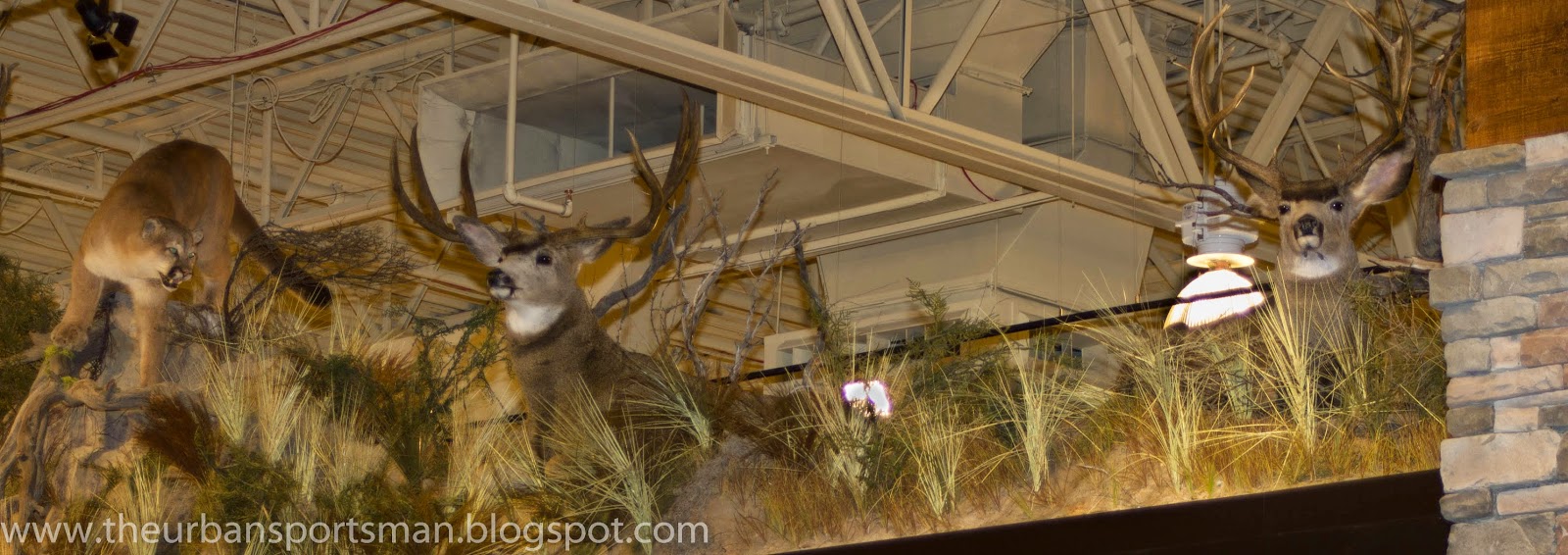
As you walk down the center aisle it situated much like a Cabelas or Basspro store with clothing on either side of the path leading you down the aisle to a mountain of mounts at the rear of the store.  The mountain is absolutely beautiful as you’d expect with a myriad of animals looking down at you from various positions and poses. 

From the mountain a quick turn right and you’re headed straight into the fishing area which is where I headed.  Field and Stream has no shortage of fishing product for you to browse through and purchase. The rods and reels are all situated by brand in the back right corner of the store while aisles of baits are situated by use just like any other large outdoors store.  However unlike some of the larger stores they have a pretty decent selection of fly tying materials for those of us who tie and fly fish.

Once you’re done in the fishing section and making your way to the front of the store between the fishing sections you’ll head right through camping supplies and into the area with canoes and kayaking supplies.  For those of us who kayak fish they have a pretty good selection of supplies for us.  From what I see their primary brand is Old Town but I’ll have to do a bit of research to see if that is who makes their F&S brand yaks and canoes.

When you head across the store you head over to the hunting section which has a large selection of hunting equipment.  For those of us there a small archery range for trying out bows and crossbows.  Of which they carry quite a few. When I was there they were giving turkey calling demonstrations which was pretty interesting for me the novice turkey hunter. 

As for the gun section they have a large section of firearms to choose from.  And guess what?  Field
and Stream has ammo for everything including the every elusive .22 rimfire.

All in all the trip was well worth it especially since I was able to snag some Berkley trout bait for the trout fishing opener at Proud Lake this year.  I’ll definitely be going on for the actual grand opening on the 26th of this month.


Field & Stream
Oakland Mall
750 W. 14 Mile Road
Troy, MI. 48083
(248) 581- 8028

Hours:
Monday - Saturday 9am to 9pm
Sunday 10am to 8pm


Thursday, January 29, 2015

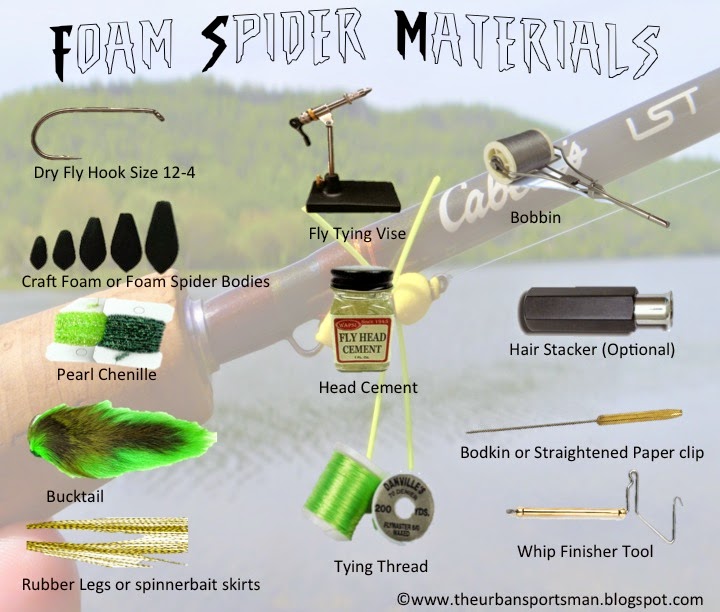
Bluegill Foam Spider Fly Breakdown


The foam spider is probably one of the easiest flies I tie as well as one of the most commonly used flies as well.  The foam spider is one of the first flies I learned how to tie and definitely the first one I caught something on.  For that reason this is a great first fly to teach young people to tie.  It can be tied in just about any size from as small as a #10 hook to as large as a #4 which when the bass are taking topwaters is very effective.  Not only that but the materials don't have to be overly precise, I've personally used basic craft foam cut to shape with scissors and cut rubber bands for the legs and the bluegill could care less.

As well it's probably the best fly for young people to fish with because it's easy to cast as well bluegill will consistently chase this fly down and eat it.  Casting the foam spider doesn't require any finesse or gentle touchdowns like casting dry flies for finicky trout.  In fact a splat landing is just fine as it gets the attention of hungry panfish as well as bass looking for an easy meal.

Basically the foam spider imitates any terrestrial that has fallen into the water.   However what I've noticed is that you can tie it in just about any color pattern but for some reason lighter bodies don't work as well and bee color patterns tend to work best right after a rain.   All in all it's a great fly to have in your box especially if you plan on harassing the local bluegill population in your neck of the woods. As well this is a great starter fly for kids.

Tying Tips:

  • Use the lightest thread you can get away with.  
  • Do not wrap an entire thread base as thread absorbs water and inhibits the fly's ability to float. 
  • Use as little pear chenille as you can, as the center thread of the chenille absorbs water inhibiting the fly's ability to float. 
  • If you find the fly is difficult to see in the water tie in a small foam bright colored indicator on the top. 


Fishing tips:

  • Let the fly splat down on to the water. This makes it seem like a bug that has fallen out of a tree. 
  • Give the initial ripples around the fly a chance to dissapate before moving the fly. 
  • Try short erratic retrieves and long retrieves to see what fish want. 
  • Use the lightest weight hook you can find. The less the weight the better it'll float.


Here is a great video tutorial of the foam spider that I tie all the time.


You may also Like:


Matching The Hatch: Wooly Bugger
Due to the simplicity and ease of use, the wooly bugger is probably the first fly every beginner learns to tie.  Continue Reading Here!


Matching The Hatch: Elk Hair Caddis
For years fly fishermen and women have had one motto or truism when it comes to picking which fly to use next and that is "Match The Hatch".  Continue Reading Here!


Fifteen Minutes to Jig Up Some Bluegill
Today I decided to sneak away during my 30 minute lunch to try out one of my hair jigs I'd tied this week.  Continue Reading Here!

Tuesday, December 23, 2014

My Christmas Present to Myself


So this years trout opener I decided that it was high time I upgrade my mode of transportation from float tube to kayak.  Don't get me wrong I love fishing from a float tube and have no thoughts of getting rid of the one I have right now.  However I like the added mobility and comfort that a kayak will give me especially in those cooler early season times. 
So what I decided to do was save my pennies and grab me a yak for next season.  With the decision to get one came the decision of what to get.  So I started reading every article about kayak fishing I could find and watching every youtube video available.  So after absorbing every bit of kayak fishing information available by osmosis I realized what things would be important factors in making my decision. 

1. Reliability was the number one thing I was looking for when checking out kayaks. From what I saw when reading reviews was that most kayaks were pretty good as far as the construction of the products.  Even the complaints on every kayak I looked at were things that were pretty easy to write off as random unfortunate occurrences in which kayaks leaked or were damaged. Not only that but a lot of the negative reviews I saw were more a matter of personal preference than manufacturers defect. So with that I saw that for the most part reliability shouldn't be much of an issue if I take care of whatever kayak I get, not only that but there is always a chance for some random manufacturers defect.  So no need to stress over what could randomly happen no matter what yak you get.  I know you get what you pay for but I also know that no man made product is without imperfections.

2. Sit on top or sit inside.  Well it didn't take too long for me to figure out I wanted a sit on top kayak. As when I started trying a few out I realized very quick that to me sit inside kayaks feel very confined which I don't care for all that much.  Also I had to consider that while I've kayaked before it isn't exactly something I do regularly so there is a high likelihood that I'll be going for a swim at least once in this thing.  With that in mind I know from summer camp experience that sit inside kayaks swamp if flipped (that's not to say that sit on top style yaks don't swamp cause they do) and can be a bit of a pain to flip back over and bail out if you take an unintended dip into the water. So sit on top it would be for me cause if I'm gonna be fishing from this thing from any large amount of time I want to be as comfortable as possible.  And when I do take a dip I want to be able to get back on the kayak as easily as possible.
 
3.  Size and weight were on my list of considerations. So when I say size I mean length and width of the yak.  Length because length plays a part in overall speed of the yak as longer kayaks tend to be faster than shorter ones.  Width because the wider the kayak the more stable the yak will be as well the wider the yak the more stable it will be if I get brave and attempt to stand and fish.  However increased width creates more water resistance and slows the kayak. So when it came to length and width I was looking for a good balance.  As for weight, this was actually more important to me than length and width. Simply because there are places I plan on fishing that don't have an actual dock to put in s I'll have to carry that yak to where ever I need to get. At least until I make myself a kayak cart. Not only that but I'll be the only person loading the yak on top of my truck whenever I go and if I find loading the kayak to be a pain odds are I just won't take it and I'll opt for the float tube.
A buddy of mine kept mentioning to me carrying capacity with my yak however this really wasn't a big deal for me since I don't weigh much myself and I personally like to fish in a minimalist fashion.

4. Price was the last of my considerations.  Not because I have a lot of money to spare but because I have no problem delaying my gratification to save and get what I want.  For that matter price wasn't really a big deal however my thought process was that this will be my first kayak so let's get something I can make some mistakes with and not break the bank since I know I'll be doing modifications to it.

With all of these things in mind I ended up picking the Bass Pro Shops Ascend FS12T (2012) fishing kayak as my Christmas present to myself. The kayak pretty much met all of my conditions and didn't break the bank which was perfect for me.  Here are the specs on the yak.


Specs:
Length: 12' 0"
Width: 31"
Weight: 68 lbs
Weight Capacity:
Price: $499 (I paid $350 cause it was on clearance)
Rudder: No

Features:
Padded seat
Bow dry storage hatch
Open Cockpit Storage
Molded foot braces
2 flush mount rod hoders
1 Center mounted Scotty rod holder

Friday, November 14, 2014

9lb Smallmouth Bass On Video

I came across this youtube video and had to share it. This is by far the biggest smallmouth bass I've ever seen.  This thing is a beast!  Thanks for Planooutdoors on youtube for sharing this video.


Friday, September 12, 2014

Understanding the Different Types of Fishing Reels


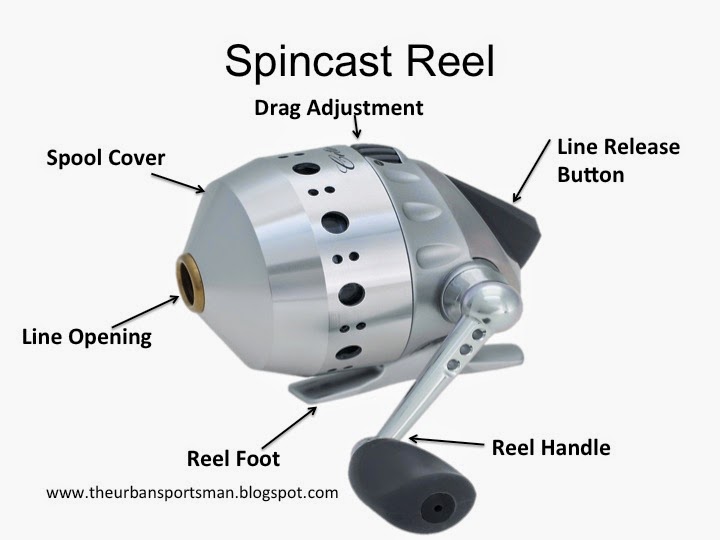
SpinCast Reel:  The spincasting reel is also known as a closed face reel because the spool and line are beneath the spool cover.  A simple press of the line release button and a flick of the wrist is pretty much all it takes to cast with this type of reel.  This is why spincast reel is probably the reel you started with as a kid.  I personally remember having a zebco rod and reel combo that I inevitably caught my first  of many different species of fish on.  I caught everything from sunfish to catfish on that little rod and reel combo eventually burning it out after a few white bass runs.

Which brings me to the pros and cons of the spincasting reel.
Pros: This reel is a great teaching tool for anyone learning how to fish as it is by far the easiest reel to use.  As well the fact that it's inexpensive gives you the flexibility of starting a kid out in fishing without breaking the bank on a hobby they may eventually cast aside.

Cons: Unfortunately because spincasting reels tend to be considered entry level reels they're often not made for high intensity usage.  As a result many, not all, spincasting reels are not very durable as they are made of inferior materials.  As well this type of fishing reel is often not the best at long distance casting and suffers from a low hauling power which is needed for hauling big fish out of heavy cover like lilly pads and submerged vegetation.

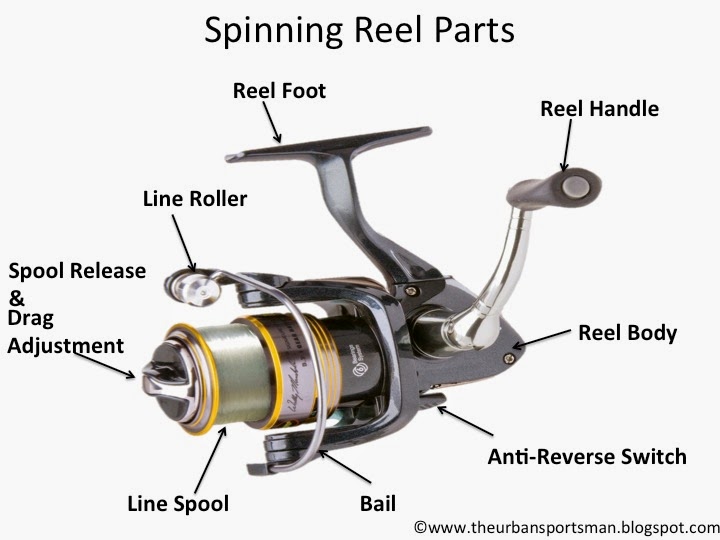
Spinning Reel:  Spinning reels are probably the more widely used reels due to the relative ease of use as well as there moderate expense.  Spinning reels are also known as open faced reels because the spool and majority of the moving parts are located externally rather than behind a spool cover.  This makes the spinning reel ideal for surf fishing where there is a high likelihood of the reel getting wet with either fresh or saltwater.  The "open face" makes most parts of cleaning much easier than with other reel types.

Most of my reels are spinning reels just because I'm a bit more comfortable using them and the fact that I can get a decent quality reel for a reasonable price.  In addition I like the fact that reel maintenance is relatively simple for those times when I'm being my usual clumsy self and I drop a rod into the water while wading or on my float tube.

Quick Tip: When picking spinning reels I tend to opt for reels with front drag systems rather than rear drags.  As the front drag has large washers that exert force on a flat surface which makes the front drag system smoother than the rear.  Where as the rear drag pushes against the drive shaft of the reel which has a smaller surface area.

Pros:  Overall the pros of using spinning reels are as follows.
1. You can get a decent spinning reel for a moderate price.
2.  Due to their open spool design spinning reels tend to hold more line that the other reel types.
3.  Spinning reels are relatively easy to use and are easy to learn to use.
4.  They are great for casting long distances and are very accurate with practice.
5.  Spinning reels are great reels when using light baits.
6.  Not prone to birds nest.

Cons:  The cons of spinning reels are as follows.
1.  Spinning reels are prone to line twist unlike baitcasters which are prone to birds nest.
2.  Spinning reels come in very limited gear ratios which limits your options for reel speeds.
3.  Unfortunately spinning reels are not powerhouses like their baitcasting cousins.  Because spinning reels actually wrap line on the stationary spool upon retrieval rather than the spool spinning hauling the line on like a wench, spinning reels are limited when it comes to hauling power.


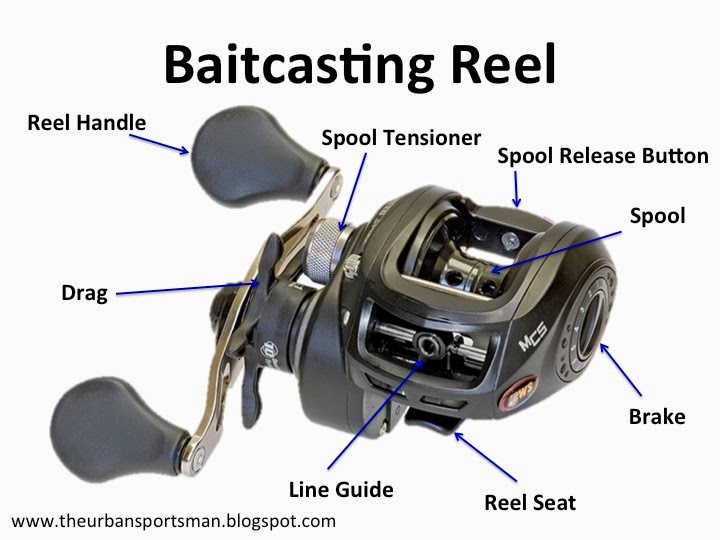
Baitcasting Reel
Baitcasting reels are quickly becoming just as widely used as spinning reels.  Where in the past you mostly saw more experienced and pro anglers using baitcasting reels now there isn't a day that I'm out on my local pond harrassing the bass and there isn't at least one other person out there using a baitcaster.

This is because more and more people are recognizing the benefits of using a baitcaster.


Pros: The pros and cons of using baitcasting reels are as follows.
1.  Baitcasting reels are wenches, of the different types of reels baitcasters have the most hauling power.
2.  Baitcasters work very well with heavier baits.
3.  Baitcasting reels offer many more gear ratios (retrieval speeds) so choosing the gear ratio that's more fitting for specific baits is far easier.
4.  Baitcasting reels also have very smooth drag systems.
5.  Baitcasting reels work great with heavier lines and super lines like braid.

Cons:  The cons of using baitcasting reels are as follows.
1.   Baitcasters are the most difficult reels to use easily getting birds nest on bad cast.
2.  Because of the steep learning curve with baitcasters it takes a bit more practice to be able to make longer cast.
3.  Baitcasters are not the best choice for lighter baits.
4.  As said before baitcasters are prone to getting birds nests in the line upon casting if not thumbed correctly
5.  Prices of bait casters can easily surpass a budget friendly place for the average person who doesn't fish that often.

Overall the different types of fishing reels are then to aid in different ways.  No one reel type is better than the other however they all just have different purposes.  As well with the technological progressions being made fishing reels are all being made with lighter and stronger materials as technology improves.  So choose wisely when choosing your next fishing reel and enjoy it for all it's worth. Thanks for reading.

LinkWithin

Related Posts Plugin for WordPress, Blogger...