Showing posts with label techniques. Show all posts

Thursday, November 14, 2013

Understanding Spinnerbaits Pt. 2 "Spinnerbait Tips"

I have to admit when I first started using spinnerbaits I had no confidence in them whatsoever.  I'd tie one on, fish with it for a little while, and catch nothing.  Subsequently I'd quickly toss the spinnerbait back into my tackle box opting for something I knew I'd catch fish with.  However, because I'm cheap and hated wasting money on baits I couldn't use, I decided I would start researching spinnerbait fishing in order to figure out what I was doing wrong.  

Well what I found is that spinnerbaits do work but work exceptionally well under certain circumstances and if used correctly.  You see, I just thought i could just cast anywhere and I'd be successful also I was under the false belief that the spinnerbait was not for use in heavy cover.  Well, I couldn't be more wrong.

The first thing I learned when I started my research was that spinnerbaits are the all around bait.  They are not limited to certain water, weather or structural conditions.  In fact they function at their very best in heavy cover and along weeds.
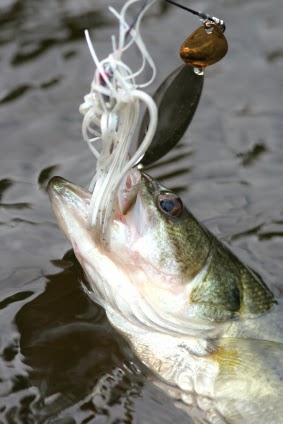


This is because spinnerbaits are best used as contact baits in other words they reap the best results when they are bumping up against structure.  That structure can be weeds, trees, stumps or the lake bottom. It's when these baits are bouncing of structure that most predator fish will grab spinnerbaits as the contact alerts bass that there is something wrong with this meal size critter making it an easy target.

As well from what I've noticed I catch more fish on spinnerbaits when it is overcast outside or in murky water.   In clear water you want to tone down the flash possibly going to singles blade spinnerbaits with copper blades to catch more fish.

Another thing I learned was that spinnerbaits fell into two categories and particularly the elbow or safety pin style spinnerbaits had some different characteristics that would make me use them differently.
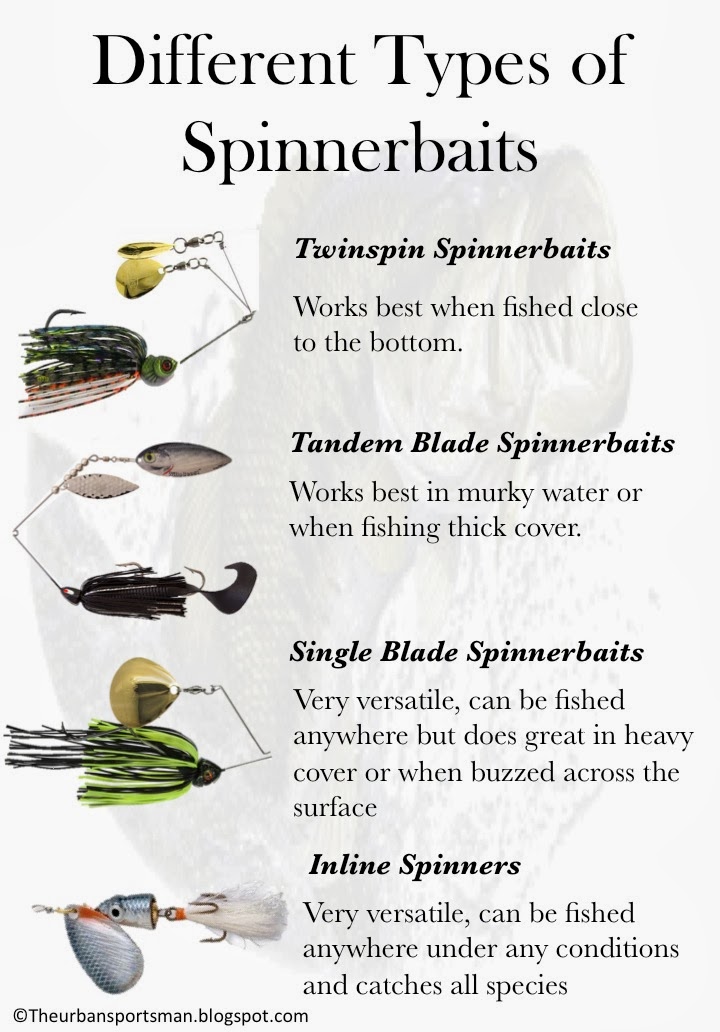
1. Twinspins: Are great when fishing along the bottom making contact with any structure along the lake bed. 
2. Long arm spinnerbaits: Can be fished anywhere the short armed spinnerbaits can but are especially suited for grassy or brushy cover as the longer arm works to keep the spinnerbait weedless. 
3. Short arm spinnerbaits: Can be fished anywhere but is especially suited for being helicoptered along ledges and vertical cover.
4. Singles blade: Great for clear water, cool water or any other time when fish aren't actively feeding. Due to their lesser amount of flash they are less likely to spook inactive fish in clear or cool water. Single blades with colorado blades can be retrieved slower with due to increased water resistance. 
5. Tandem Blades: Work great in murky water or conditions where visibility is low.  

Different Spinnerbait Retrieves
Slow Roll:
This retrieve is good when bass are resting deep along drop offs or submerged cover.  Simply cast into shallow water that leads to the drop off where the fish are holding.  With your rod tip pointed downward reel slowly allowing your spinnerbait to bump the bottom or the tops of any weedy or brushy cover following the lakes drop off to the bass.  

Helicopter:
Helicoptering your bait is almost self explanatory.  Pretty much you real to the edge of some sort of vertical cover, like a wall or stump, and let the spinnerbait fall along the edge causing it to flutter like a helicopter into the strike zone of any fish waiting at the base of the vertical cover. 

Waking or bulging:
Bulge a spinnerbait by retrieving so the blades spin just below the surface causing a bulge or wake in
the surface.  This is one by casting past your intended target cover, lifting your rod tip and reeling just slow enough to make the blades spin just beneath the surface never breaking the surface tension.  This technique will produce a unique sound and vibration that will attract bass in shallow murky water.

Buzzing: Buzzing is pretty much the same as waking or bulging.  The only difference is that you need to speed up your retrieve so the blades break the waters surfaces causing the spinnerbait to buzz along the surface.

Note: 
Rigging:  Use medium to medium heavy rods at lengths of 6.5 to 7.0 ft in order to get long cast on your spinnerbaits while giving you the backbone needed to set the hook at longer distances.  As well use high gear ratio reals in spooled with 12lb to 20lb test monofilament when spinnerbait fishing.

Trailer Hooks:  If you're gonna use trailer hooks make sure you use shorter shank hooks in order to increase hookups while staying as snag free as possible.  As well if the structure permits rig the trailer hook upside down in order to increase hookups as well. 

Overall I've learned quite a bit about fishing with spinnerbaits this last summer but I still have a long way to go.  I've been lucky enough to catch quite a few 3lb smallmouth and largemouth bass on spinnerbaits after I developed some confidence in them.  If you haven't used spinnerbaits yet make sure you try them as soon as you can as they are truly big fish baits. 

Thanks For Reading,
Kwan


Tuesday, September 17, 2013

Quick Tips for Better Squirrel Hunting


Squirrel hunting, it's highly underrated and too much fun to ignore.  Whenever I mention it to any non-hunter the first thing the first thing they mention is how easy it must be to hunt squirrels.  Every time I hear this I can't help but giggle because their only opinion of squirrels and squirrel behavior comes from their views of the local squirrel digging through their trash or raiding the bird feeder.

Well if your idea of squirrels are the black and gold semi-tame trash bandits you see everyday in your neighborhood you are sadly mistaken of what truly wild squirrels are like.  First of all, squirrels that live in the woods are far more shy of people especially since they rarely see an actual person intruding on their woods.  On the occasions that they do see people they see us just like any other predator.  When they see a predator they run for the safety of their trees and clam up quick.  A few squirrels that were just barking and chasing each other around will disappear just as fast as you can snap a twig with your big clumsy boots.  However there are some things that will help you bag a few more bushy tails this small game season.

Listen Closely 
Sometimes the only way you'll locate the nefarious bushy tail is when they drop something from the trees.  So listen for falling branches and acorns.  While a squirrel may not make a sound when they've spotted you once they think they've out foxed you or that you've moved on they'll go back to feeding, albeit quietly.  So listen up for falling twigs and nuts.

SHH!  Be quiet
Think of squirrel hunting kind of like mini-deer hunting.  You can either sit and wait for them to move or you can do some stalking on the little guys.  Either way you have to be quiet especially if you're doing some calling and stalking.  One of the things I've done to aid me in my stalks is to ad some felt to my rubber boots to muffle the sounds of twigs underfoot.  Just because they're squirrels doesn't mean they're not smart enough to avoid predators and whether you like it or not you're a predator.

Don't look for squirrels
Early season can have you looking in trees loaded with leaves for squirrels that can use a large oak leaf as a hiding spot.  So one of the things I've learned is to don't look so hard for an actual squirrel but look for the moving branches that give away their movements.  That doesn't mean not look for actual squirrels it just means you have to be keyed in to the signs especially in early season when they are much harder to spot.

Start Barking
One of the things I've found fun and helpful when out bagging bushies is to call for them.  A couple of barks on a squirrel call will have squirrels barking back at you from all over the woods.  It's pretty cool especially if you have young hunters with you.  Have them start yipping away and they'll be excited from that  forward.  Also if you don't know what to do when you start calling take some time and listen to what the squirrels in your neighborhood are saying and mimic them.  But most all have fun with it.

Improve your odds with a PODS
Depending on your weapon of choice squirrel hunting is all about precision shooting.  So make sure you practice a lot before season starts.  Also to make it easier to hit a target as small as a squirrels head make sure you pack a bipod or monopod to get a solid rest.  This way once you've silently moved into position you won't have to waste time trying to settle the natural movement of your body so much to clear a good shot.   Remember a squirrel's head is not too much larger than a couple of quarters so you don't have much room for error so practice and bring a POD with you.

Look beyond your target
No matter what weapon you use to take your game you always have to think SAFETY FIRST.  This is just as true with squirrel hunting a .22 or .17 bullet can do just as much damage as a .45.  Make sure you're when you shooting at brush running squirrels be on the look out for hunters orange or other unwanted targets.  Also when you're aiming up in the air or on the ground at your target make sure you have a backstop.  If your aiming at a squirrel sunning itself and there is nothing but open air behind it, wait until you have a backstop.  After all bullets, buckshot and arrows are subject to gravity and must come down somewhere.


Hopefully I'll see you outdoors soon
Kwan

LinkWithin

Related Posts Plugin for WordPress, Blogger...